Agentic Barometer — Waitlist

Where you are.
How fast to move.

The baseline for Fortune 500 AI transformation. An index built from evidence, not hype.

  • Monthly reporting, straight to your inbox
  • Segments, benchmarked - including F500 FinServ
  • Board-ready insights and talking points
You've joined the waitlist.
Oops! Something went wrong while submitting the form.
By submitting your email, you consent to receive marketing and communications from Archevia.
For senior leaders and the advisors around them.
How Its Made

Built like software.
Engineered by a practitioner.

We think of the Agentic Barometer™ as a digital product, not a report.
Our proprietary AI agents do a lot of the heavy lifting – reading the evidence and applying the same measures month after month – but our analysts make the final calls as to how the research is positioned.

The final point of view comes directly from Zar Toolan, our founder, so you’re getting the sharpest practitioner read on F500 AI adoption and what we are seeing actually move the needle.

Zar Toolan
Founder, Archevia Advisors · Editor, The Agentic Barometer™
Why It's critical

Navigate the changing terrain

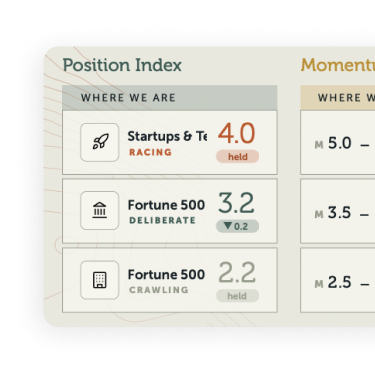
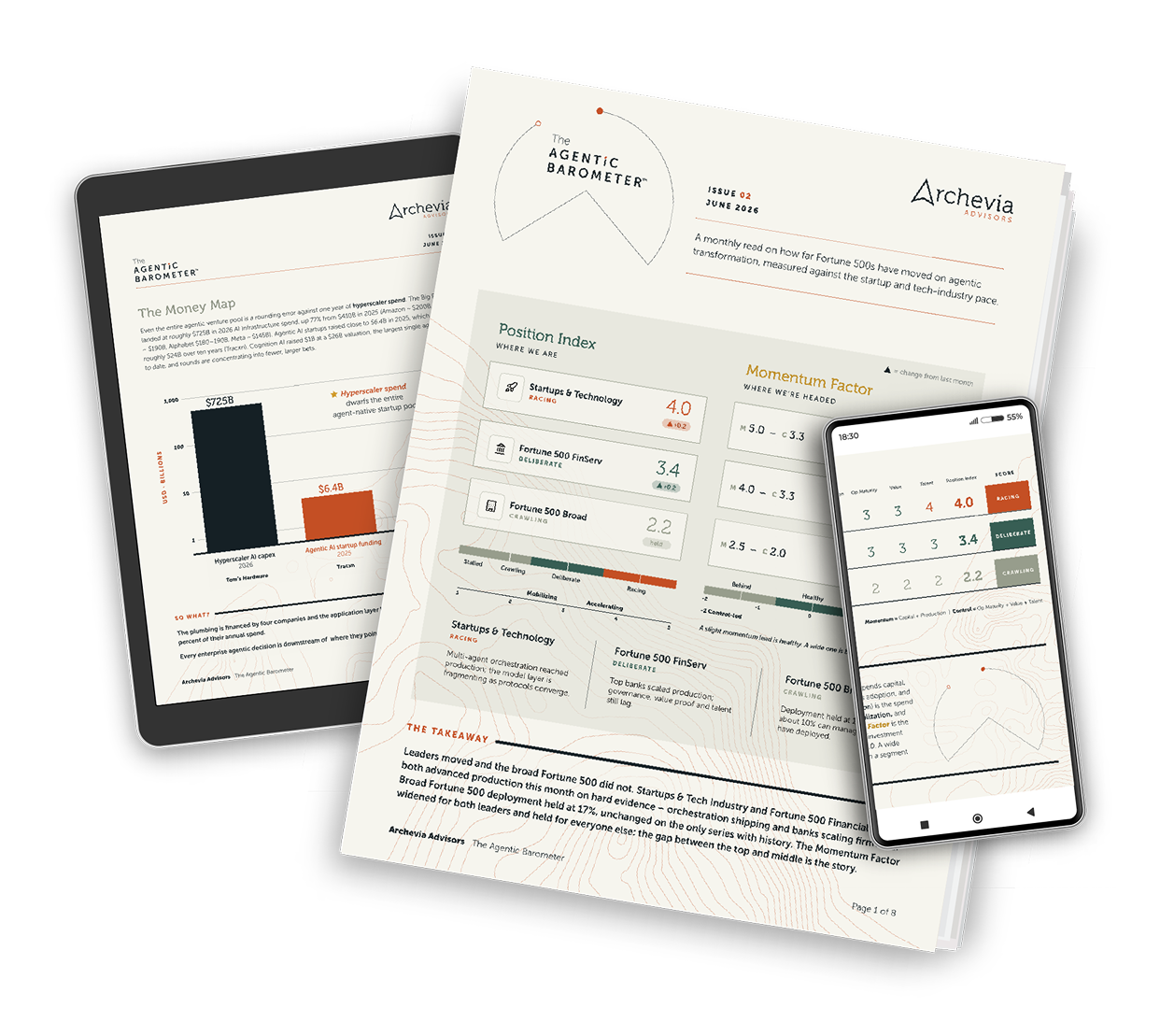
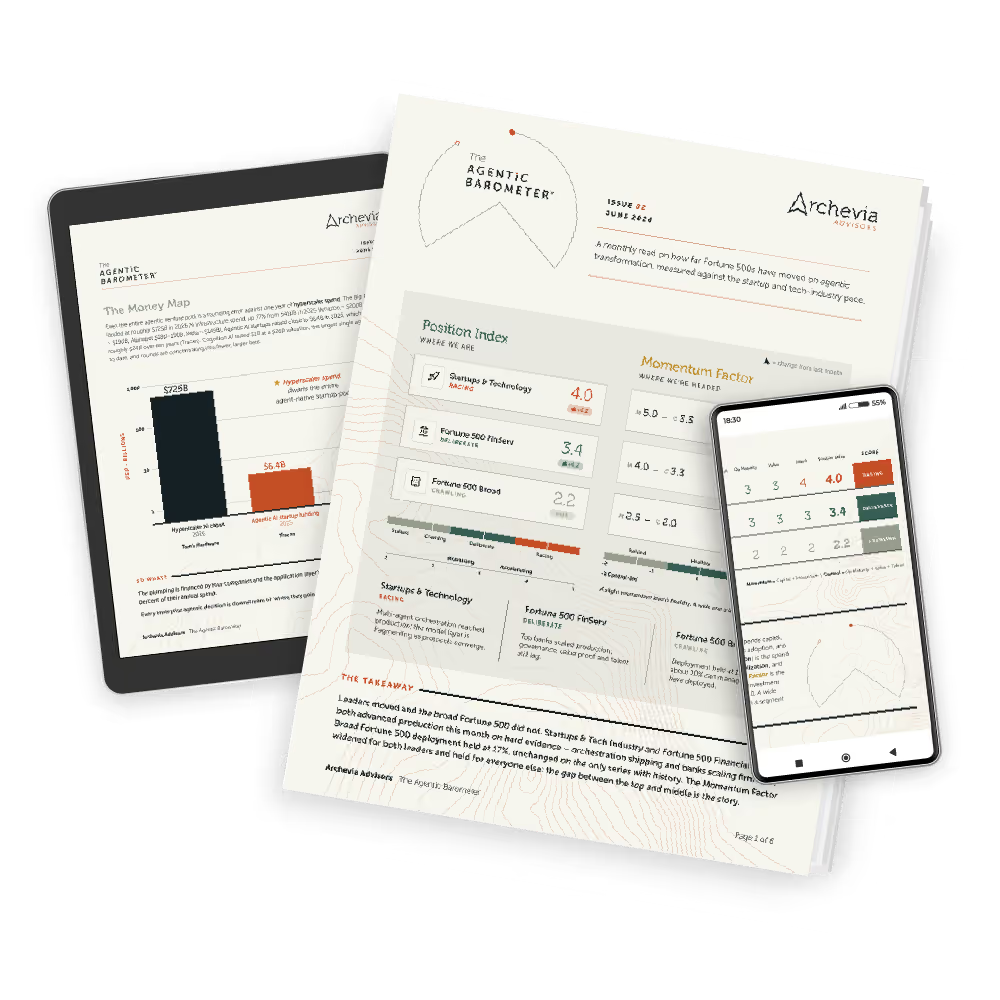
The Agentic Barometer™ provides a monthly, evidence-based benchmark of enterprise AI progress: where the Fortune 500 stands and where the segment is heading.
1

Evidence, not announcements

Every month, the Barometer reads the evidence for what the Fortune 500 is running:

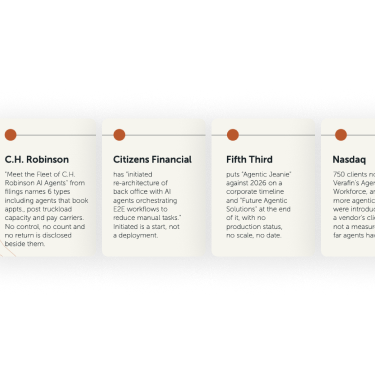
  • Sourced from regulatory filings, supervisory reports, and primary research
  • Separates what's announced from what can be shown running in the business
  • Identifying the line between hype and reality
2

Know where you stand

The Barometer scores five measures, read in the order transformation actually happens:

  • Money committed
  • AI products running in the business
  • Controls and oversight in place
  • The people and ownership to adopt it
  • Value proven

It reads three groups against them - the broad Fortune 500, tech and startups as the pace-setter, and a drill-in on financial services - so a leadership team sees where its segment sits and what's holding it back.

3

Talk about AI with confidence

Every month, the Barometer turns the data into two things a leader can use:

  • Insights on what the evidence shows
  • Executive talking points for board meeting, client calls, and strategy sessions
4

Know how fast to move

This is the Momentum Factor: whether a segment's AI spending is running ahead of its ability to govern, adopt, and prove it.

  • A small lead is healthy - investment should run a little ahead of the payoff
    A wide lead means money's moving faster than the segment can absorb - that's burn, not progress
5

Follow the money to the earnings

The Barometer follows two numbers - what a segment spends on AI, and what it reports back in earnings.

  • Capex in: the money committed to AI
  • Earnings out: what's actually showing up in results
  • Read against your own segment, a starting point for seeing whether the spend is turning up in the results
THE PRODUCTION PARADOX

The distance between what companies announce and what goes into production

62%
of organizations say AI agents are live in production.
74%
have already rolled one back or shut one down after deployment.
69%
have rolled one back or shut one down in financial services.
Source: Sinch, "The AI Production Paradox" - 2,527 organizations across 10 countries, fielded January to February 2026. Vendor-sourced; population screened on AI deployment intent.
Agent Defined

What counts as an agent?

We get this question a lot. “Agentic” describes AI that does more than answer - it decides and it acts. We define AI agency by its level of autonomy and decision-making ability, and the samples below are based on what we’re seeing in the marketplace:

Assistive Agents

This can be some general info about "assistive"

What it does

Produces something when asked: a draft, a summary, a classification, a suggested reply. It does not act on its own output.

Who decides

A person, every time. Nothing reaches a customer or another system unless someone puts it there.

Typical use cases

Summarizing internal documents and answering questions from them, suggesting an email reply for a person to send, extracting and classifying data, code assistance.

Delegated Agents

This can be some general info about "delegated"

What it does

Takes an instruction and completes the steps itself, pulling data and calling other software without being walked through each decision.

Who decides

The system chooses sequence and method inside limits set in advance. A person sets the boundary, not each action.

Typical use cases

Account intake and opening, portfolio rebalancing inside a scoped account, scheduling and booking appointments, shipment and order updates, refund handling.

Orchestrated Agents

This can be some general info about "orchestrated"

What it does

Several agents run a process end to end, handing work between them, with one directing the others and auditing the output.

Who decides

Mostly the system. A person moves to design, monitoring and handling exceptions.

Typical use cases

Autonomous procure-to-pay, supply chains that reorder and reschedule themselves, period-end close, contract lifecycle handling.

The benchmark

Most of what your leadership team believes about enterprise AI readiness came from someone selling it. The Agentic Barometer™ is the monthly correction. It reads how far the Fortune 500 has really moved on AI transformation and answers the two questions a board keeps asking: where the enterprise actually stands, and how fast it should be moving.

Access The Agentic Barometer™

You've joined the waitlist.
Oops! Something went wrong while submitting the form.
By submitting your email, you consent to receive marketing and communications from Archevia.